Housing disrepair, under Ctrl
See what’s driving your disrepair claims and handle them faster – with your team in control. Ctrl AI reads a disrepair claim and your own repair records together – building the chronology and assessing liability, merits and quantum – so your team responds within the protocol window and sees which stock and defects are driving claims across your portfolio. The repairs and safety decisions stay with your team.

Why social landlords choose Ctrl AI
Whether you’re a housing association, an ALMO or a council, Ctrl AI helps your team handle disrepair claims faster and more consistently, and see what is driving them across your stock – so you can respond within the protocol window, settle the indefensible and defend the spurious and target repairs where they will actually reduce claims. Our AI does the analytical groundwork. Your team makes every decision, including every repair and safety call. Your organisation handles the claim and fixes the home.
A clear view of every claim, faster
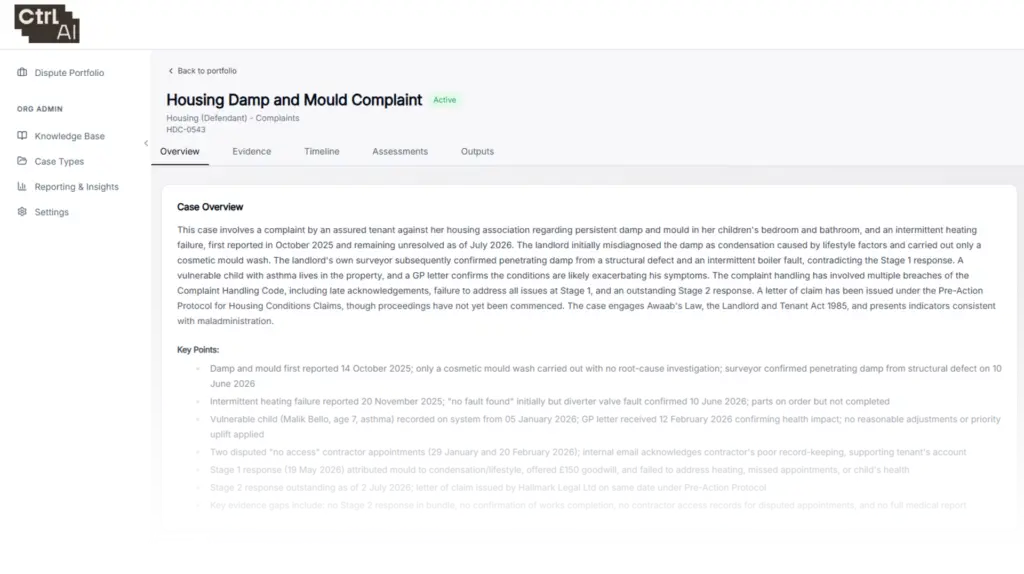
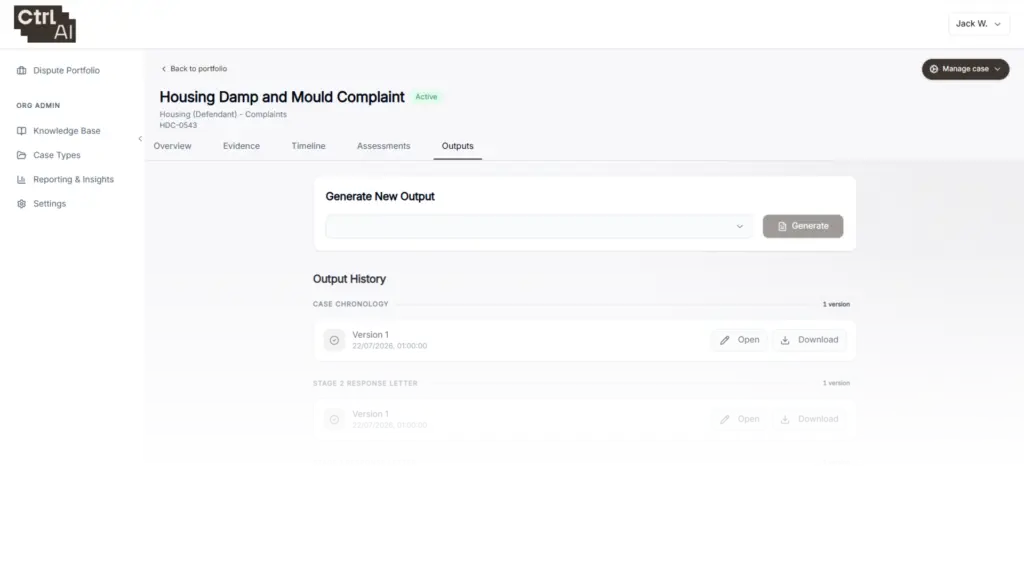
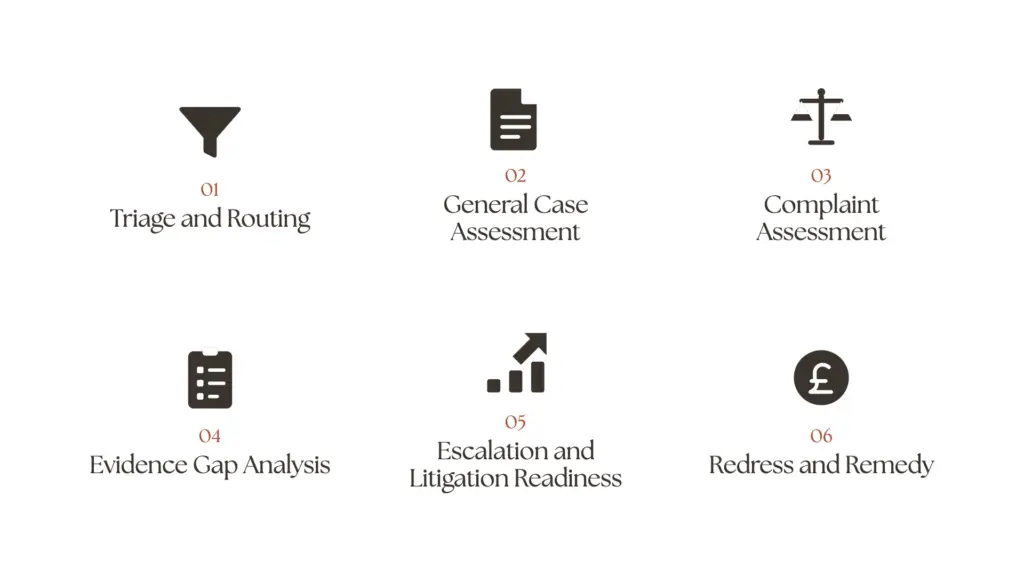
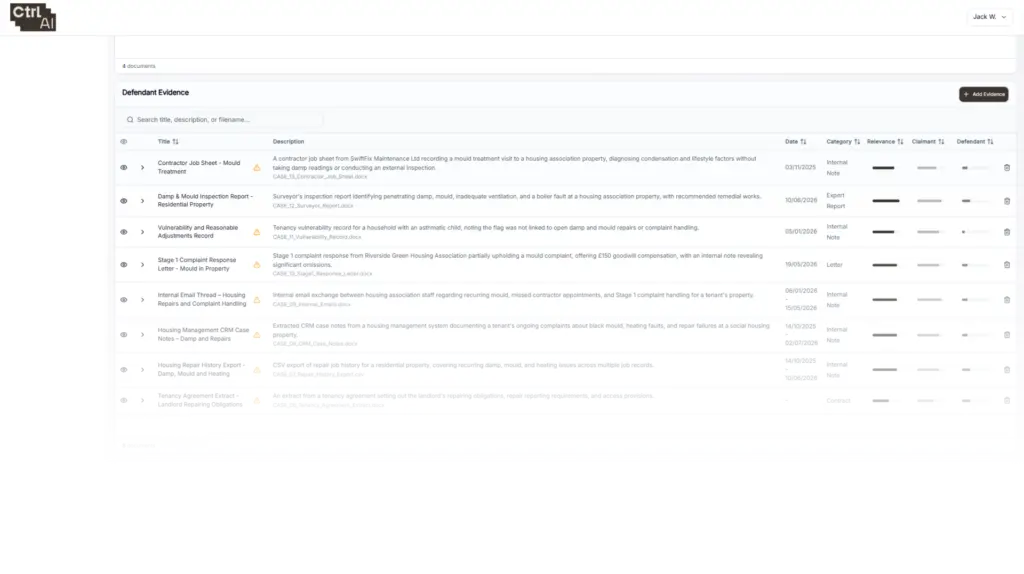
When a Letter of Claim arrives under the Pre-Action Protocol, the clock starts and the repair records have to be assembled and disclosed – usually scattered across systems. Ctrl AI reads the incoming claim and your own evidence together (repair history, complaints, surveyor reports, correspondence), builds the chronology and produces a structured assessment of liability, merits and likely quantum, along with the counter-schedule.
Your team starts from a clear, evidenced position instead of building it by hand – so the indefensible can be settled quickly and the spurious defended, within the protocol window.
Your team decides. The AI does the groundwork
Ctrl AI never decides a claim – and never decides a repair or a safety priority. It does the analytical groundwork: it reads the evidence, applies the protocol and the current law and drafts the assessment and the counter-schedule. Your team reviews, edits and decides and every repair and safety judgement stays with the people qualified and accountable to make it.
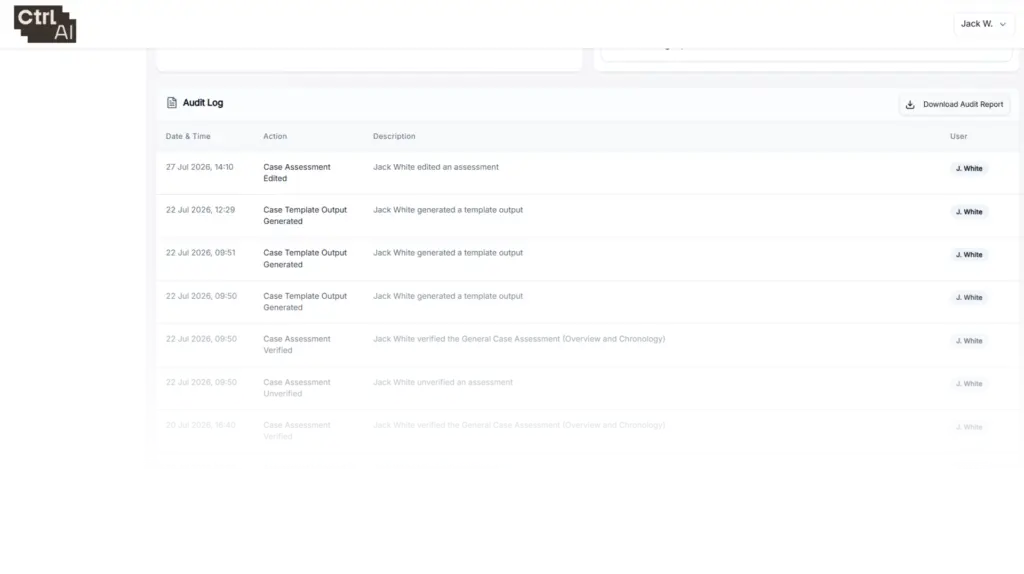
Every output is an editable starting point, not a finished answer and every input and edit is logged. That audit trail is there for your board or cabinet, the Regulator and the Housing Ombudsman – and it is what makes the platform safe to adopt in a service where safety comes first.
See what's driving your claims. Fix the cause, not just the case
A claim is not just a case to handle – it is a signal about a home. Because Ctrl AI assesses every claim against the record, it surfaces the patterns a case-by-case view misses: the archetypes, estates, defect types and contractors that keep generating claims and hazards across your portfolio.
That gives your team the evidence to target repairs and investment where they will do the most good – fixing the cause, not just answering the case. It is the difference between defending claims and reducing them. The platform surfaces the pattern; your team decides where to invest and puts it right.
One standard, across every case. And every surveyor
A large landlord’s disrepair response involves many people making judgements – surveyors, handlers, contractors – and consistency is hard to hold. Ctrl AI applies the same framework (the protocol, the law, your approach) to every claim, so the same evidence produces the same structured assessment and the same quality of counter-schedule, whoever runs it.
The judgement stays human; the standard behind it is consistent, and the whole file is audit-ready – for your board or cabinet, the Regulator and the Ombudsman. Consistent handling is fairer for residents and far easier to defend.
Keep more in-house. Spend less on claims
Disrepair is a rising cost against a constrained budget – an association’s, or a council’s ring-fenced Housing Revenue Account. Ctrl AI helps you handle more claims well in-house – assessing, disclosing and responding – instead of sending everything to a panel firm, so external legal spend falls. Every claim kept in is cost avoided.
When a claim genuinely needs the firm, it goes over on one shared platform – the evidence and the assessment already done – so the firm starts ahead and bills less. And because you own the platform, the portfolio insight stays with you: one consistent view across everything, instead of reports scattered across firms on different systems.
Frequently asked questions
Does the AI make repair or safety decisions?
No – and this is by design. Ctrl AI does the analytical groundwork: it reads the evidence, applies the protocol and the current law, and drafts the assessment and counter-schedule. Your surveyors, your team and your lawyers make every call – including every repair and safety decision. Every step is logged in a full audit trail, so the process is defensible for your board or cabinet, the Regulator and the Ombudsman.
Is this a repairs or compliance system?
No. Ctrl AI is a disrepair-claims assessment and insight suite – it reads and assesses claims and surfaces the patterns across your portfolio. It is not a repairs-management system, an asset system, or an Awaab’s Law compliance tracker; those stay with your operational systems and your team. It sits alongside what you already run and the value it adds is a clearer, faster, more consistent view of your claims – and the insight into what is driving them.
Does this work for councils and ALMOs, not just housing associations?
Yes. Ctrl AI is built for social landlords of every kind. Housing associations, ALMOs and local authorities all face the same Pre-Action Protocol claims, the same Awaab’s Law duties, and the same consumer standards and Housing Ombudsman scrutiny – and councils often carry the oldest stock and the sharpest damp-and-mould exposure. The platform fits council governance and reporting – cabinet, elected members and scrutiny – just as it fits an association’s board and it can be procured through the public-sector frameworks councils already use.
How is this different from HabitatGuard or a Scott Schedule tool?
Operational tools automate the Scott Schedule and protocol responses at the document level. Ctrl AI goes deeper: the full assessment workflow – liability, merits and quantum and the counter-schedule – plus the portfolio root-cause insight into which stock and defects are driving claims. It can sit alongside the tools you already use; the difference is analytical depth and the systemic view, not single-document automation.
Where does our data go, and how is tenant data handled?
Your data stays in your instance of Ctrl AI on UK-hosted infrastructure, encrypted at rest and in transit, with AI processing inside an isolated, encrypted environment in the EU. Tenant records carry special-category data and are handled accordingly, and you control retention and deletion. A full security pack is available on request, covering Cyber Essentials, our infosec controls and data-protection templates.
Does the AI train on our data?
No. The platform is grounded in the Pre-Action Protocol, the current law and your own approach at the point of assessment. It is not retrained on your claims and your data is never used to improve external models.
How does it fit with our housing management and asset systems?
Ctrl AI sits on top of your systems of record. It works alongside your housing management system (such as NEC, Civica Cx, MRI or Aareon) and your asset system (such as Keystone or Apex), via API where supported or as a side-of-desk deployment. Your systems aren’t replaced and your IT roadmap isn’t rewritten.
Will it replace our team?
No. Ctrl AI is assistive, not autonomous. By compressing the manual work – assembling records, building chronologies, drafting assessments and counter-schedules – it frees your team to spend its time on judgement, on residents and on putting homes right. It is a tool for handling rising claim volume and seeing what is driving it, not for cutting the team.
What about the claims we send to our panel firms?
The point is to hand over less – and later. Handle more well in-house, and when a claim does need to escalate, your panel firm picks up the same file on one shared platform – evidence and assessment already done – so it starts ahead and costs less. Because you own the platform, the portfolio insight stays with you rather than being scattered across different firms on different systems.
How is Ctrl AI priced and how quickly can we be live?
Ctrl AI is licensed to your organisation and scaled to your size and claim volume. Implementation is fast: we configure the platform to your approach in weeks, usually starting with a proof of concept on a small sample of your real claims so you can see how it reasons – and how well it copes with your data – before you commit. It sits on top of your existing systems, so there is no rip-and-replace. For councils and ALMOs, it can be procured through the public-sector frameworks you already use. We can share a pricing outline on request.