Housing disrepair claims, under Ctrl
Run more cases, to a consistent standard – without overloading your team. Ctrl AI runs the analytical backbone of a claimant housing disrepair claim – triage, evidence, Scott Schedule comparison, quantum – so your fee earners spend more of their time on judgement, clients and negotiation.
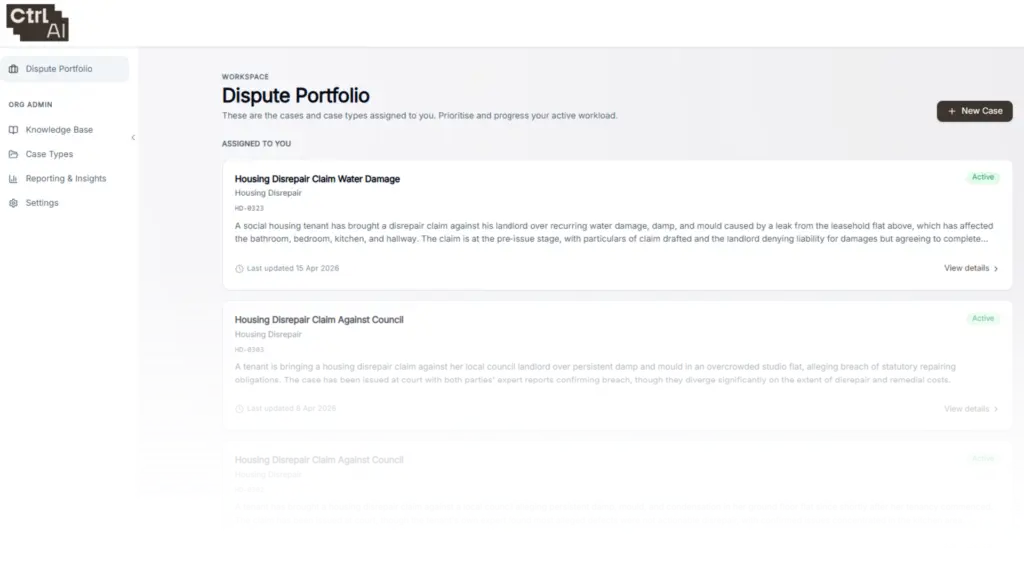

Why housing disrepair claimant teams choose Ctrl AI
Ctrl AI helps your team take on more claimant housing disrepair cases, to a consistent standard, at the volume rising demand and regulatory change now require. Every assessment is structured around the Pre–Action Protocol, evidence gaps are highlighted at intake and your claims handlers sign off every output. Our AI does the groundwork. Your team makes the decisions. Your firm runs the case.
Progress more claims.
With the same size team
With the same size team
The bottleneck isn’t the judgement – it’s the routine, repeatable work around it: sifting records to vet a case, assembling the notice trail, working line-by-line through the parties’ Scott Schedules. Ctrl AI runs that work in the background, comparing the claimant’s and defendant’s schedules to show what’s agreed, what’s denied, and where the defendant’s position is weak – so a Scott Schedule review drops from three hours to 45 minutes. With reduced onboarding durations, your claim handlers get that precious time back for the cases that need their judgement.
AI does the groundwork. Your claims handler decides the outcome
Ctrl AI takes in the evidence and produces a structured assessment, which a claims handler then accepts, edits, or rejects. Nothing leaves the platform – no Scott Schedule, no Letter of Claim, no quantum figure – until someone on your team has signed it off.
Every output is an editable first draft, not a finished answer. Our AI platform works like a second pair of eyes alongside your handlers, surfacing the detail that’s easy to miss in a large bundle.
Your best handler's standard.
On every case
Quality can vary from handler to handler: one team member may catch a notice gap that another misses; Scott Schedule comparisons are approached inconsistently; quantum is calculated differently for the same disrepair profile. Ctrl AI applies the same framework to every case – defined ratings for claim strength, significance, priority and quantum confidence – so the same evidence produces the same structured assessment, whoever runs it and whenever.
A handler with three months’ experience produces work to the standard of one with ten years. Consistent quality, regardless of experience – and faster onboarding, because the methodology lives in the assessment, not in one person’s head.
Built around the Pre-Action Protocol. Flags missing evidence at intake
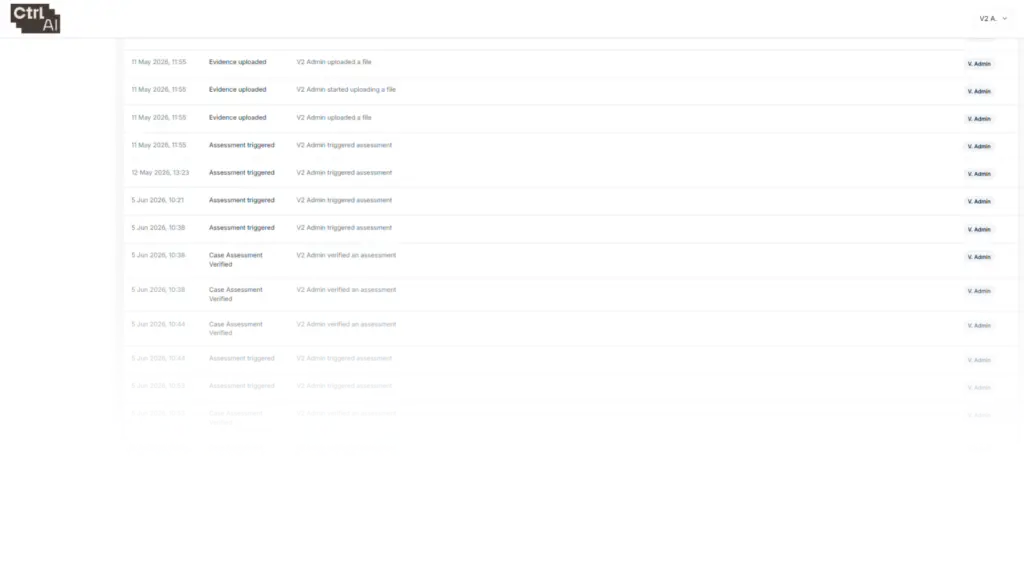
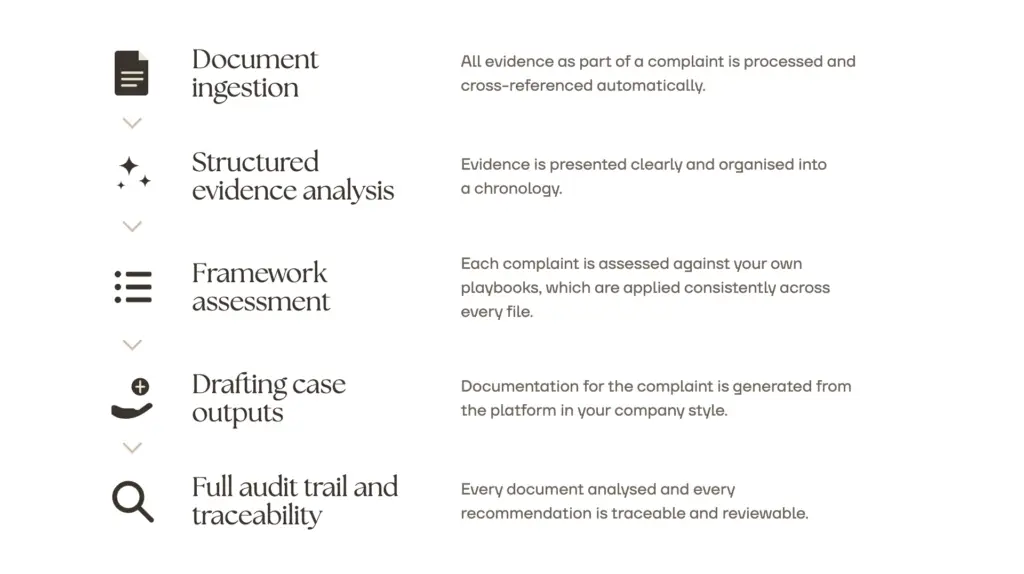
Ctrl AI does the heavy lifting for your handlers – sifting evidence, building a case chronology, applying your playbook, drafting the first cut of every output – then hands it back to a named handler to accept, edit, or reject. Nothing leaves the system and no determination is logged, until a team member has signed off.
Every time a handler agrees with the AI, edits it, or overrides it, that decision is captured – giving you a feedback loop, not a replacement loop. Over time, the way your best handlers work becomes the way the system works for everyone. Your handlers train the AI, not the other way around.
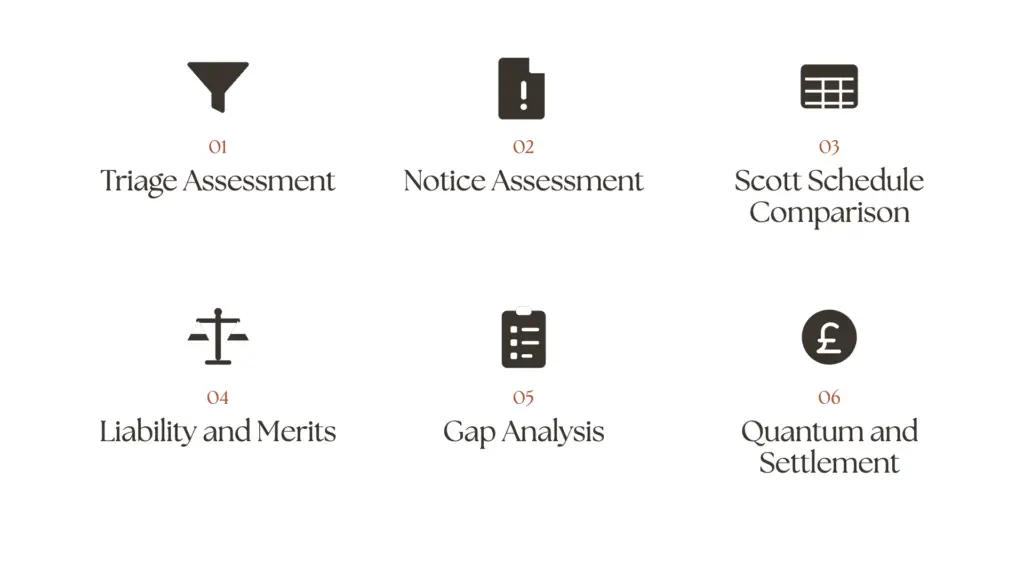
Six assessments, ready to run. Alongside the software you already use
Your handlers upload the evidence, choose the assessment they need, and get a structured output back – with no prompt engineering or AI expertise required. Six assessments are ready to run today: Triage, Notice Assessment, Evidence Gap Analysis, Scott Schedule Comparison, Liability and Merits, and Quantum and Settlement. Each one works across your whole caseload as opposed to document by document. All assessments are fully configurable and can be adapted to suit your workflow.
Rather than replacing the case management system you already run, Ctrl AI sits on top of it – working with Proclaim, Sharedo, Clio or a bespoke build, either through an API or as a side-of-desk deployment.
Frequently asked questions
Where does our data go and how is it stored?
Your data stays in your instance of Ctrl AI on UK–hosted infrastructure. This data is encrypted at rest and in transit, with AI processing inside an isolated, encrypted environment in the EU. You control retention and deletion. A full security pack is available on request, covering Cyber Essentials, our infosec controls and our data–protection position.
Does the AI train on our data?
No. The platform is grounded in the Pre–Action Protocol and your firm’s approach at the point of assessment. It is not retrained on your cases and your data is never used to improve external models.
Will this replace our fee earners or hollow out the team?
No. Ctrl AI is assistive, not autonomous. By compressing the manual time on triage, notice assembly, evidence gaps, Scott Schedules and first drafts, it frees your fee earners for the judgement, negotiation and client work only they can do. It’s a tool for scaling volume, not for cutting headcount.
Why not just use ChatGPT, Claude, Copilot - or Harvey or Legora?
Generic AI gives a different answer every time, is prone to hallucination and has no Scott Schedule, quantum or Awaab’s Law logic, no notice–trail handling and no audit trail. Legal–AI tools like Harvey and Legora work case–by–case and need configuring to your workflow. Ctrl AI does not simply generate text or summaries – it applies a structured framework consistently across your whole caseload, returns the same assessment on the same evidence and logs every step.
How does it work with our existing case management system?
Ctrl AI is a system of action that sits on top of your system of record. It works alongside Proclaim, Sharedo, Clio or a bespoke build – via API where supported, or as a side–of–desk deployment with no CMS changes. The Scott Schedule exports straight to Excel. Your CMS isn’t replaced and your IT roadmap isn’t rewritten.
Our CMS vendor says they are adding AI - why bring in a separate tool?
Case management and case assessment are different layers. Your CMS handles workflow – intake, routing, reporting. Ctrl AI handles reasoning – evidence, assessment against the Protocol and the law and drafting. CMS–vendor AI tends to focus on workflow and status, not the structured assessment work where a housing disrepair department needs consistency and a defensible file.
Why buy from Ctrl AI when we could build something in-house?
Building gives you a minimum viable product in twelve to eighteen months, plus the ongoing AI–operations headcount to run it – and a build that won’t keep pace with Awaab’s Law Phase 2 and new case law. Ctrl AI is live now, on a verification–first architecture built for housing disrepair, with ongoing R&D – new case types, model evolution, keeping current with the law – that you don’t have to fund yourself.
What does a typical implementation look like?
Three stages. A complimentary proof of concept where we run a small number of your real cases through the platform without configuration, so you can see how it reasons. Then a configuration phase – including Proclaim integration and volume–scaling setup – where we tune the outputs to the position your firm would take. Then go–live. Months, not a year.
How is Ctrl AI priced?
Pricing scales with your active caseload – you only pay more when the platform is delivering more. Most firms start with a complimentary proof of concept, add configuration and integration as a defined phase, then move to a subscription matched to volume. One contract, phased fees and a clean exit. We’ll share a pricing one–pager on request.