
Ombudsman and ADR leaders discuss AI in casework at Ctrl AI’s London event
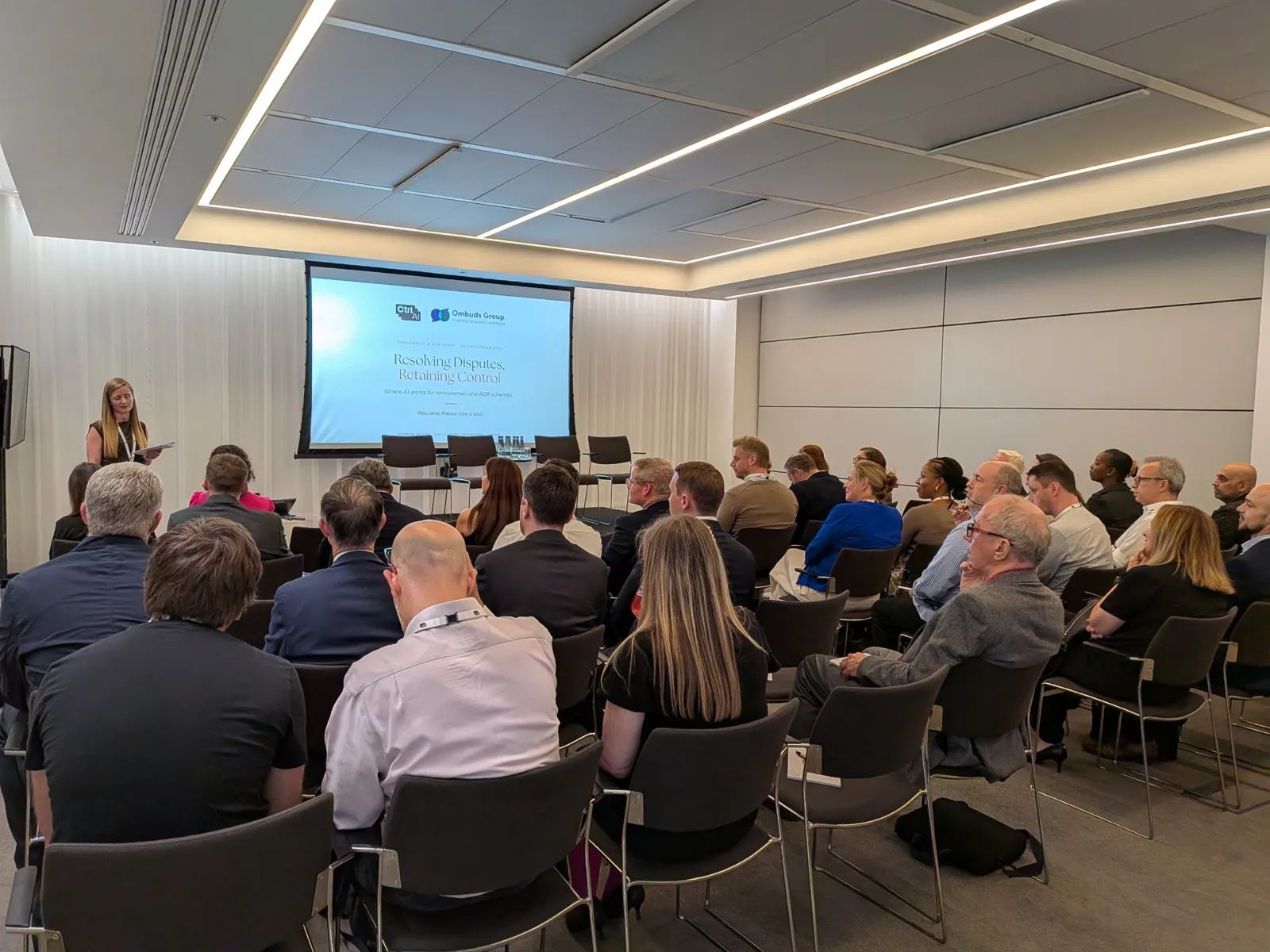
Ctrl AI’s evening event at Mishcon de Reya brought chief ombudsmen, ADR scheme leaders and casework and quality leads together to discuss the use of AI in casework.
- Event
- Resolving Disputes, Retaining Control
- Date
- 30 September 2026
- Where
- Mishcon de Reya, London
On 30 September 2026, chief ombudsmen, ADR scheme leaders, case handling and quality leads and legal teams filled a room at Mishcon de Reya in London to talk about what AI can realistically do for dispute resolution. The evening opened with two keynotes, one on access to justice and one on vulnerability, followed by a practitioner panel moderated by Jennifer Ryans, Director of Strategic Partnerships at Ctrl AI.
One idea ran through all of it. AI is already changing both sides of a dispute, and the schemes getting the most from it are the ones designing for the people using their services, with case handlers firmly in charge of every decision.
AI in access to justice
Professor Naomi Creutzfeldt of Kent Law School opened by pointing out how quickly AI has become a default. Colleagues, friends and students now turn to ChatGPT or Claude for everyday questions, and people bringing complaints are no different. She argued that schemes need to look at AI through two lenses: the institution providing the service and the consumer using it.
On the institutional side, her research with The Ombuds Group found that AI did not reduce the need for professional expertise. Good results depended on how well practitioners could articulate what they needed, and on a back-and-forth with the output rather than expecting something ready to use.
The consumer side is harder. Giving people prompts to guide their use of AI could help, but it also risks making complaints more uniform and adding volume to already stretched systems. Meanwhile many vulnerable consumers are already using AI without any guidance, and the result is often a long, poorly directed submission. Naomi’s conclusion was that AI should strengthen accessible routes to justice rather than replace human support, and that inclusion has to be designed in from the start. Otherwise AI risks reproducing the disadvantages that already exist.
Designing for someone’s worst day
Louise Baxter MBE, Chief Executive of Consumer Friend, asked the room a simple question: would your service help or hinder someone on their worst day? Most services, she said, are designed for people having a good one.
Vulnerability is situational rather than a fixed trait. Bereavement, job loss, financial pressure or a mental health episode can make anyone vulnerable, and FCA data shows 49% of UK adults have at least one characteristic of vulnerability. Yet only 17% of people declare it, held back by stigma or simply not recognising it in themselves. That leaves services to spot the rest.
Louise also set out how much of the population struggles with standard communication:
- The average UK reading age is between 9 and 12, and 7.1 million adults read at the level of a 9-year-old or below.
- 43% of UK adults cannot understand NHS communications, rising to 61% when numbers are involved.
- Around 20% of the population is neurodivergent, and designing for them produces services that work better for everyone.
The consumers of the future will be more overwhelmed still, spending around 4.5 hours a day online and making so many small decisions that fatigue drives quick, low-quality choices. Louise closed by asking organisations to change the question they ask. Rather than asking what is wrong with the person, ask what is wrong with the service.
The panel: why they started
Jennifer Ryans was joined on the panel by Lesley Horton, Chief Ombudsman at The Property Ombudsman; Samantha Clark, Head of Individual Dispute Resolution at Acas; Amy Goss, Legal Innovation and Solutions Manager at Winston Taylor; and Judith Turner, Deputy Chief Ombudsman at The Ombuds Group. Each came to AI for a different reason.
Lesley described a 60% rise in case volume in a single year, against constrained revenue in a competitive market. She also needed assurance that roughly 15,000 decisions a year were being made consistently.
Samantha said demand at Acas had risen from around 2,000 to around 3,700 cases a week, and that recruitment alone could not close that gap. Acas has moved from discovery into prototyping and testing, working within the government assessment processes that apply to a legally regulated body.
Amy said clients were asking law firms to show how they use AI. Winston Taylor started with specific areas of work that are repetitive and low in recovery value.
Judith framed it less as a problem to fix and more as a chance to innovate. The Ombuds Group used its existing case management system, Tizo, as the entry point.
Where AI is already improving outcomes
The most memorable example of the evening came from The Property Ombudsman. Lesley explained that case handlers used to spend half a day building a chronology. With AI helping on that work, the time now goes on human contact, and she said the organisation has become more human as a result.
The Property Ombudsman has also built vulnerability flagging into its process. Everything a consumer submits is checked for signs of vulnerability, and any flags appear in front of the case handler before they open the case. The time saved elsewhere has gone into phone calls, and case handlers have been trained specifically in speaking with vulnerable consumers by phone.
At Winston Taylor, Amy described AI handling the initial document review and fact extraction on employment claims. That leaves advisers to focus on considered judgement and client strategy.
Judith gave an example from The Ombuds Group of evidence gap analysis. For each case it shows what evidence is present, which side it supports and what is missing. Case handlers can then contact consumers early to help them strengthen their submissions.
How consumer AI is changing complaints
The panel agreed that AI on the consumer side is already changing what arrives. One rail scheme has seen a 20% rise in complaint volume and a 50 to 60% rise in case file weight in 12 months.
There are benefits. Some complaints arrive better formed, and it can be easier to identify whether a case falls within a scheme’s jurisdiction. But submissions are longer and harder to parse, and finding the core issue can take real effort.
The bigger effects are on expectations and trust. Consumers who have run their complaint through AI tend to be more confident they will win, which makes early settlement and conciliation harder, and employment claims are lasting longer as a result. Some consumers treat AI as an authority, so when a scheme reaches a different view they assume the scheme has got it wrong. At Acas, parties now run live conciliation calls through AI and challenge conciliators with legislation that sometimes does not apply, which makes conversations longer and conciliation less effective.
The panel also raised what was described as AI mass vulnerability. Polished, AI-written language can hide the distress that a complaint written in someone’s own words would show, which makes Louise’s point about spotting undeclared vulnerability even more pressing.
Where the human line sits
Every panellist agreed that any dispute affecting a real person needs a human escalation path. Where they differed was in how they build that into day-to-day work.
Winston Taylor keeps a person involved at every stage. No AI output reaches a client without a lawyer signing it off, and nothing happens automatically. At Acas, the prediction tools used to route cases all sit under human oversight, with escalation pathways built in.
The Property Ombudsman has thought carefully about how it frames the AI’s role. Instead of a suggested outcome, case handlers see what would tip the case, meaning the lines of investigation and the evidence that could change the result. Lesley said this avoids the “computer says yes” problem and keeps the case handler’s judgement at the centre. A quality framework tracks both over-reliance and under-reliance on AI at an individual level.
The Ombuds Group takes a similar approach to consistency. Its case management system flags case handlers who accept every AI output without challenge. Judith described the review standard as a range of reasonableness, so the question is whether an output is reasonable rather than whether it matches what the case handler would have written.
Bringing case handlers along
The Property Ombudsman did not call it AI at first. It launched as a casework enhancement tool, starting with workshops that asked case handlers what got in their way and what would make their jobs easier. Word then spread from colleague to colleague, and Lesley said advocates within the team were more persuasive than anything leadership could say. Training covered how to use the system, but also what AI is, where it can go wrong and how processes needed to change around it.
At The Ombuds Group, the focus was on giving teams the confidence to challenge outputs and say when something is not right. Judith described a real shift in skills, from drafting to reviewing, sense-checking and critically evaluating what the AI produces. One of their champions has kept an implementation diary since October last year, and she recommended it as a resource for organisations just starting out.
Across the panel, one piece of advice came up repeatedly: bring the sceptics into the project team. Their knowledge of how the organisation really works makes them some of the most valuable testers you have.
Advice for schemes starting out
Each panellist offered advice for organisations at the start of their own work with AI.
- Amy: start with the business problem, not the solution, and map the whole process before choosing any technology.
- Lesley: don’t use AI for the sake of it. Resist pressure from the board to just do something with AI, and find what fits your organisation, your people and your service users.
- Samantha: people, then process, then technology, in that order. Build the problem statement from user experience and case handler input together.
- Judith: embrace it, because your service users already are. Not understanding AI creates its own risk.
An audience question on measuring return on investment drew a frank answer: there is no formula yet. Acas tracks outcomes in three areas, which are managing demand, access to conciliation and progression to tribunal. The Property Ombudsman remapped its processes, estimated the time saved at each stage and is now running a live comparison with and without AI in one jurisdiction.
Thank you
Thank you to Naomi, Louise, Lesley, Samantha, Amy and Judith for speaking so openly, to Mishcon de Reya for hosting us and to everyone who came.
Continue the conversation
If the discussion raised questions for your own scheme, these are the best places to pick it up.