Know which cases to run, sooner
For claimant clinical negligence teams
Ctrl AI indexes and paginates the medical records, builds a chronology of care linked to every page and screens breach and causation for your team and your experts. Clinical and legal judgement stays with the professionals.
The clinical negligence market
Claims against the NHS keep growing, and government is under pressure to cut what it pays in legal costs.
new clinical negligence claims and incidents reported in 2025/26, up 5.6%
NHS Resolution Annual Report, Jul 2026paid out on NHS clinical claims in 2025/26, including £622m of claimant legal costs
NHS Resolution Annual Report, Jul 2026average claimant legal costs on claims worth up to £25,000, more than the damages paid in that band
NHS Resolution Annual Report, Jul 2026The operational challenges, and how Ctrl AI helps
| Operational challenge | leads to | How Ctrl AI helps |
|---|---|---|
Cost per case is under pressureFixed recoverable costs for claims up to £25,000 are confirmed but not yet in force, and investor-backed firms are raising the bar on cost per case. | Bundling in-house, priced per caseRecords are split, sorted, indexed and paginated in-house on the platform, and the per-case price can be recovered as a disbursement. | |
Senior time goes on dead-end enquiries84% of claims resolve without court proceedings, yet senior lawyers spend hours on enquiries that will never become cases. | Enquiries screened before senior timeEarly triage screens each enquiry from the intake form, grounded in NICE guidelines and Royal College of Nursing standards, with breach and causation always considered together, for a solicitor to decide. | |
Thousands of pages arrive out of orderRecords arrive out of order, duplicated and partly handwritten, and outsourced pagination adds weeks. | Thousands of pages put in orderRecords are split into documents, sorted by provider and given court-compliant pagination and a bookmarked index, with a chronology of care linking every entry, handwritten ones included, to its page. | |
Experts instructed before the gaps are knownInstructions go out before the gaps in the records are known. | Gaps known before the expert is instructedDuplicates and missing periods are flagged so the gaps can be requested first. Solicitors plan the instruction from the chronology and test the expert’s report against the records when it arrives. |
The platform, set up for medical evidence
Built around the records bundle, because that is where clinical negligence cases are won and lost.
Bundle preparation
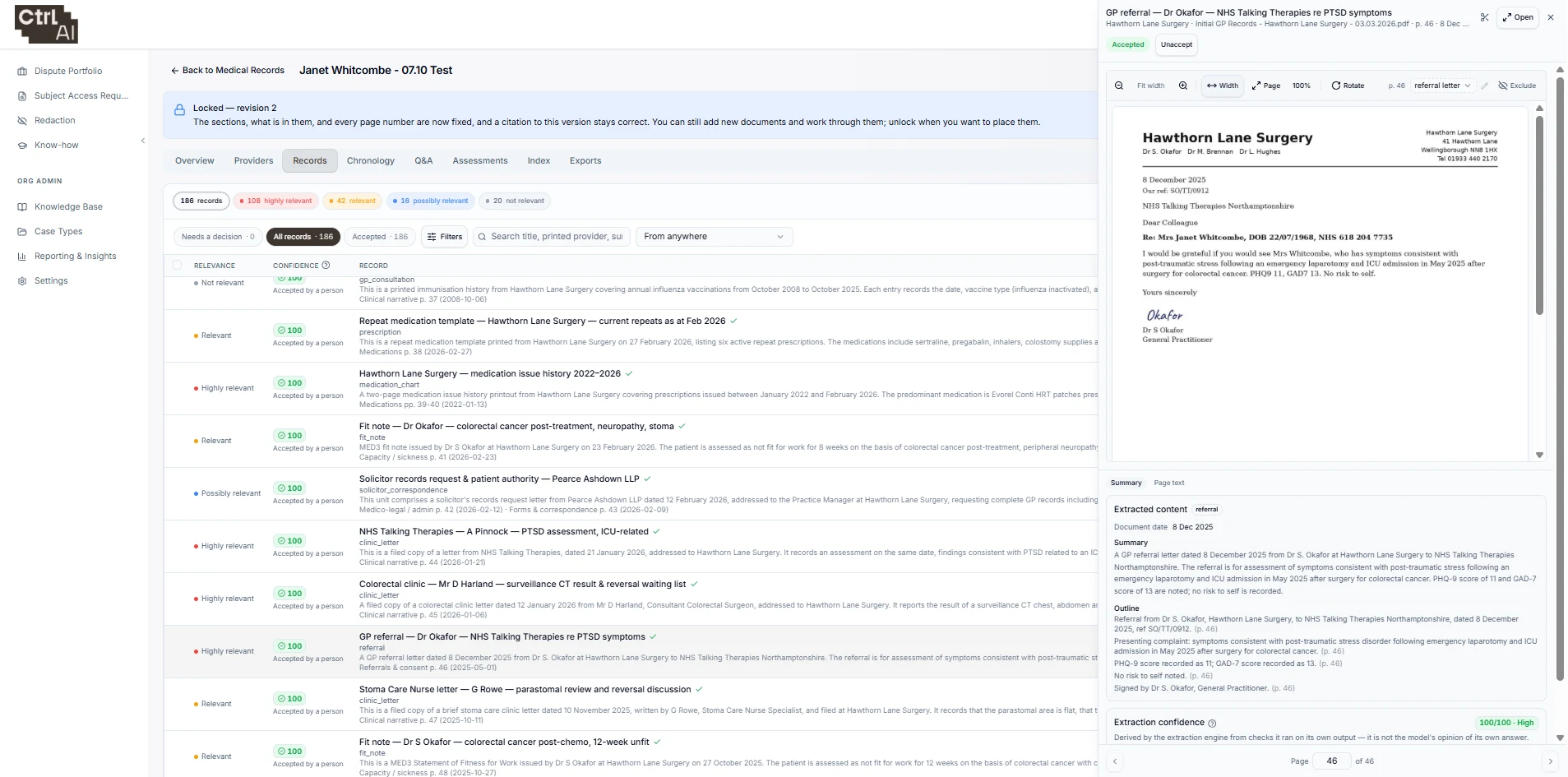
Splits the records into individual documents, sorts them by provider and builds a bookmarked, hyperlinked index with court-compliant pagination.
Bundle locking
Lock the bundle and add later disclosures without renumbering pages the expert already has.
Chronology of care
Every consultation, test and treatment in date order, linked to the page it came from, handwritten entries included.
Ask the bundle
Ask a question of the records and get an answer cited to the page.
Duplicates and gaps
Flags duplicate records and missing periods, so you can request them before instructing an expert.
Early triage
A structured screen from the intake form, grounded in NICE guidelines and Royal College of Nursing standards, with breach and causation always assessed together.
Pre-expert and post-expert review
Plan the expert instruction from the chronology, then test the expert’s report against the records when it arrives.
Verification
Every assessment is checked by a named solicitor before it is used. The record shows who reviewed what.
Frequently asked questions
Does Ctrl AI make clinical judgements?
No. It organises the records and surfaces the relevant clinical standards, such as NICE guidelines and Royal College of Nursing standards. Solicitors and medical experts reach the conclusions on breach and causation.
Can we stop outsourcing pagination?
Yes. Records are split, sorted by provider and given court-compliant pagination and a bookmarked index on the platform. Later disclosures are added without renumbering pages the expert already has.
How is it priced?
Per case, and the price can be recovered as a disbursement.
Does it read handwritten records?
Yes. Handwritten entries appear in the chronology of care alongside typed ones, each linked to the page it came from.
How does it help before we instruct an expert?
Duplicates and missing periods are flagged so you can request them first, and you plan the instruction from the chronology. When the report arrives, you can test it against the records.
Where are the medical records held, and are they used to train AI?
Client data is stored in the UK and processed in the EU, encrypted at rest and in transit, and never used to train AI models. We are ISO 27001 certified, and our information security pack is available on request.
See Ctrl AI on a medical records bundle
Start with a no-commitment trial on a closed case.