Resolve more disputes. Hold every decision to the same standard
For ADR schemes, adjudicators and mediation teams
Ctrl AI reads both parties’ evidence, puts the events in order and tests the case against your scheme rules. Your adjudicators spend their time on the judgement, and every decision they issue traces back to the evidence.
Where ADR is heading
More disputes are being steered away from court and towards independent resolution, and the rules on who can provide it have tightened.
county court claims issued in April to June 2026, up 11% on a year earlier
MoJ Civil Justice Statistics, Sep 2026last day traders can use consumer ADR providers approved under the old rules
DMCC Act 2024 ADR regimeThe operational challenges, and how Ctrl AI helps
| Operational challenge | leads to | How Ctrl AI helps |
|---|---|---|
Accreditation puts consistency under scrutinyConsumer ADR providers have needed accreditation since 6 April 2026, which puts consistency between adjudicators under scrutiny. | Consistency you can show at accreditationEvery case is assessed against your scheme rules and codes of practice in the same way, and reporting shows where adjudicators overruled the AI. | |
More cases come from the courtsJudges can order parties into ADR since Churchill v Merthyr Tydfil (2023), and most small money claims now go to a free mediation appointment first. | More cases, each read on arrivalThe platform reads every new case’s evidence inside your case management system, including scanned and handwritten material, and scores each document for relevance and for the party it came from. | |
Two accounts and no common recordThe consumer sends a narrative, the trader sends screenshots, and nobody has put the events in order. | One timeline holding both accountsThe timeline puts both parties’ events in order, shows both accounts where they disagree, and lists what each party claims but has not evidenced. | |
Submissions arrive longer and AI-draftedA two-page complaint can arrive as a 40-page argument citing rules your scheme does not apply. | Long submissions tested against your rulesEach issue raised is assessed against your own scheme rules, codes and guidance, with citations an adjudicator can check line by line. | |
Reading crowds out decidingEvidence review and chronology take 60 to 70% of a case handler’s time, by our analysis of UK schemes. | Deciding starts from a file already readEach case opens with a source-linked chronology, and the decision letter is drafted from the assessment your adjudicator verifies, so their time goes on the judgement. | |
Out-of-scope cases still get a full readCases outside your remit take a full read before anyone spots the problem. | Remit checked before the full readEach new case is tested against your eligibility rules, such as time limits, membership, value thresholds and whether the trader’s own complaints process is complete, with unclear cases passed to a person. |
The platform, set up for ADR
One platform, configured to your scheme’s terms of reference, rules and decision letters.
Evidence from both parties
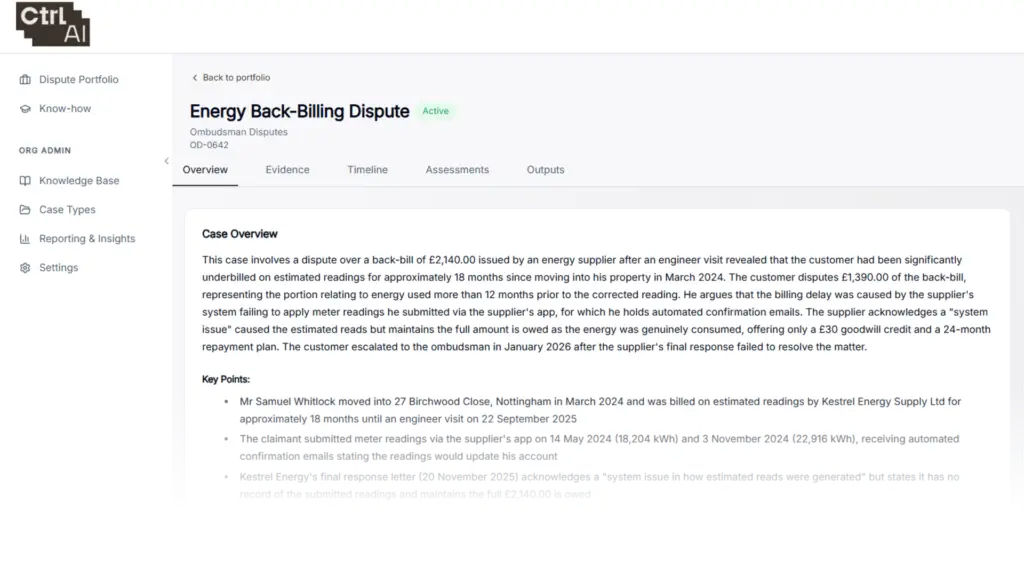
Submissions arrive through your case management system or by upload. Ctrl AI reads typed, scanned and handwritten material and scores each document for relevance and for the party it came from.
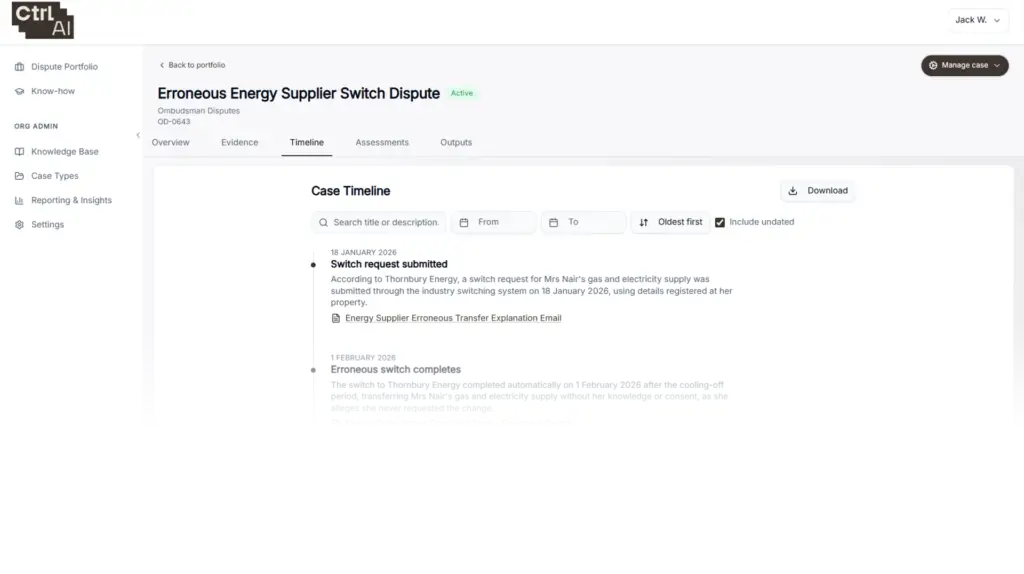
Dispute chronology
A timeline built from the dates inside the documents, with every entry linked to its source. Where the parties disagree about an event, the timeline shows both accounts.
Remit check
Configurable eligibility tests, such as time limits, membership, value thresholds and whether the trader’s own complaints process is complete.
Scheme assessment
Works through each issue against your rules, codes and guidance, with reasoning and citations an adjudicator can check line by line.
Evidence gap analysis
Lists what each party claims but has not evidenced, so you can ask for it before the decision rather than after a challenge.
Draft decisions
A draft adjudication or decision letter in your house style, produced only from the assessment your adjudicator has verified.
Inside your case management system
Runs embedded in systems such as Tizo and Workpro, or as a standalone workspace with document upload.
Scheme reporting
Themes across your caseload, repeat issues by trader and the points where adjudicators overrule the AI, for quality review and annual reporting.
Frequently asked questions
Does Ctrl AI decide cases for our adjudicators?
No. It reads both parties’ evidence, builds the timeline and tests the case against your scheme rules. A named adjudicator verifies the assessment and makes the decision, and nothing is sent until they have.
Will it work inside our case management system?
Yes. It runs embedded in systems such as Tizo and Workpro, or as a standalone workspace with document upload. Your case management system stays the system of record.
How is this different from ChatGPT or Copilot?
There is no prompt box. Each assessment is a defined task configured to your scheme rules, so every case is assessed against the same questions, every finding cites the page it relies on and every action is logged.
Can we show consistency for accreditation?
Every case is assessed against your rules and codes in the same way, and each edit and override stays with the case. Scheme reporting shows where adjudicators overruled the AI, for quality review and annual reporting.
Where is case data held, and is it used to train AI?
Client data is stored in the UK and processed in the EU, encrypted at rest and in transit, and never used to train AI models. We are ISO 27001 certified, and our information security pack is available on request.
How do we get started?
With a no-commitment trial on your own closed cases, so you can judge the output against decisions you have already made. We then configure the platform to your rules, codes and decision letters, and price it per case.
See Ctrl AI on a case from your scheme
Start with a no-commitment trial on your own closed cases.