Investigate more cases without lowering the bar
For ombudsman schemes and their investigation teams
Ctrl AI prepares the file, tests it against your scheme’s approach and drafts the decision. Your investigators make the finding, and the reasoning behind every outcome stays visible to the parties, your managers and anyone who reviews it later.
What is changing across the ombudsman sector
Demand on UK redress schemes keeps rising, and the cases arriving are harder to read.
escalated complaints a year across the UK’s 55 to 70 ombudsman and redress schemes
Ctrl AI sector analysis, 2026caseworkers across those schemes, almost all on case management systems with no AI decision support
Ctrl AI sector analysis, 2026of investigator time spent on evidence review and chronology rather than judgement
Ctrl AI sector analysis, 2026The operational challenges, and how Ctrl AI helps
| Operational challenge | leads to | How Ctrl AI helps |
|---|---|---|
Caseloads rise while budgets stay fixedMost of the UK’s major schemes reported higher caseloads in 2025/26, and budgets do not move with demand. | The caseload screened for remit firstEach case is tested against your rules, such as time limits and whether the firm’s own process is exhausted. Clear passes go to investigation and unclear cases go to a person. | |
Complaints arrive longer and AI-writtenA growing share of submissions are drafted with AI, and some run to hundreds of pages. | Long complaints broken into their issuesThe case assessment works through each issue against your rules, codes and published approach, citing the evidence so investigators can test every point. | |
Every chronology is rebuilt by handInvestigators rebuild the chronology on every case before they can test what went wrong. | One chronology built from both partiesComplainant and firm submissions merge into one timeline, every event linked to source and conflicting accounts side by side, and missing evidence is listed with the party that holds it. | |
Consistency is hard to proveTwo investigators can reach different outcomes on similar facts, and quality review only sees a sample. | Consistency visible on every caseEvery case is assessed against the same rules and published approach, and each edit and override is kept with the case, so quality review can test any file. | |
Every use of AI is scrutinisedParties, boards and sponsors want to know who made each decision and on what evidence. | AI prepares, a named investigator decidesEach assessment stays unverified until a named investigator signs it off, and the reasoning cites the evidence it relied on. | |
Repeat failings stay buried in filesRepeat failings by the same firm or sector sit across hundreds of cases. | Repeat failings drawn out across casesReporting picks out recurring issues and repeat failings by firm and sector across your caseload, ready for your systemic work. |
The platform, set up for ombudsman casework
Configured to your rules, guidance and decision templates, usually in one to two weeks.
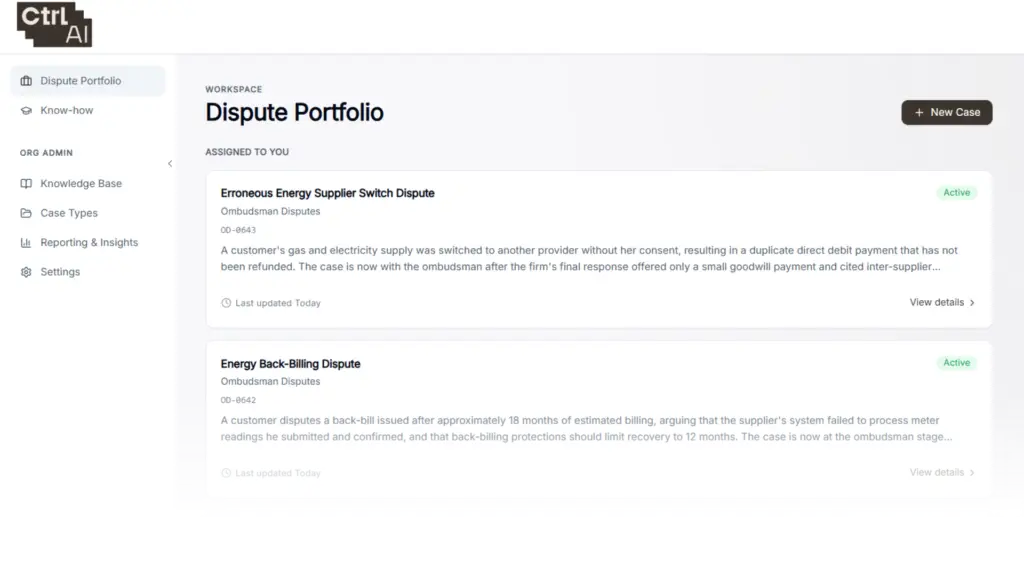
Remit and jurisdiction check
Tests each case against your rules, such as time limits and whether the firm’s own process is exhausted. Clear passes go to investigation and unclear cases go to a person.
Chronology across both parties
Complainant and firm submissions merged into one timeline, every event linked to source, with conflicting accounts shown side by side.
Case assessment
Issue-by-issue analysis against your rules, codes and published approach, with reasoning and citations the investigator can test.
Evidence gaps
What has been claimed but not provided, and which party holds it, so information requests go out early.
Redress assessment
A structured view of what putting things right looks like under your approach, for the investigator to confirm or change.
Draft decisions
Provisional decisions, final decisions and closure letters drafted from the verified assessment, in your scheme’s format.
Verification record
Each assessment stays unverified until a named investigator signs it off. Edits and overrides are kept with the case.
Fits your systems
Embedded in your case management system by iframe or API, or used standalone with document upload.
Frequently asked questions
Does the AI make the finding?
No. Ctrl AI prepares the file, tests it against your rules and published approach and drafts the decision. Each assessment stays unverified until a named case handler signs it off, and the reasoning cites the evidence it relied on.
Can we explain our use of AI to the parties and our board?
Yes. Every action on a case is logged, edits and overrides stay with the case and the record shows who verified what and when. Anyone reviewing a decision later can see the evidence behind each point.
Our case management supplier is adding AI. Why would we need Ctrl AI too?
Case management and case assessment are different layers. Your system runs intake, routing and reporting. Ctrl AI reads the evidence, assesses it against your rules and drafts, embedded in your system by iframe or API or used standalone.
Will it shrink our team?
It is built to help the same team handle rising demand. Ctrl AI prepares the evidence review and chronology, so case handlers spend their time on the judgement.
How long does configuration take?
Usually one to two weeks, after a trial on your own closed cases. We configure the platform to your rules, guidance and decision templates, and your team confirms the outputs match the position your scheme would take.
Where is case data held, and is it used to train AI?
Client data is stored in the UK and processed in the EU, encrypted at rest and in transit, and never used to train AI models. We are ISO 27001 certified, and our information security pack is available on request.
See a case from your scheme in Ctrl AI
Start with a no-commitment trial on your own closed cases.