Get the response right first time, before it reaches an ombudsman
For complaint and customer resolution teams in regulated businesses
Ctrl AI brings the complaint, the account history and your policy together, tests the case against your regulator’s rules and drafts the final response. Your handlers review it, so fewer complaints escalate and the ones that do arrive with a complete file.
What complaint teams are up against
Regulators are shortening the clock and asking firms to prove fair outcomes, while volumes stay high.
complaints to financial services firms in the second half of 2025, with 55.5% of those closed upheld
FCA aggregate complaints data, May 2026a month in staff time UK businesses spend dealing with poor service
Institute of Customer Service, UKCSI Jan 2025The operational challenges, and how Ctrl AI helps
| Operational challenge | leads to | How Ctrl AI helps |
|---|---|---|
The ADR clock is shorterSince April 2026 telecoms customers can go to ADR after six weeks instead of eight. | The shorter clock goes on the decisionEmails, letters, call notes, chat logs and account records are brought into one timeline, each entry linked to its source, so the handler’s time goes on the investigation and the response. | |
Fair outcomes must be evidencedUnder the Consumer Duty, firms must show how they support customers when things go wrong. | Outcomes evidenced issue by issueEach issue is assessed against your policy and the rules that apply, including the Consumer Duty, and the handler verifies the assessment before any response is drafted from it. | |
Redress events add to the day jobThe FCA’s motor finance redress scheme alone covers 12.1 million agreements. | Redress at volume, to one standardEvery case gets the same assessment and a proposed remedy in line with your compensation policy, which a handler confirms or changes. | |
One letter holds several complaintsCustomers raise several issues at once, often in long AI-drafted letters. | Every issue in the letter answeredThe letter is split into its separate issues, each assessed in turn, and the final response is drafted from that verified assessment so it addresses every one. | |
Every escalation brings a case feeAn ombudsman referral brings a case fee and more work, even when your decision was right. | Escalation risk flagged at triageTriage flags escalation risk and vulnerable customers, and a case that does escalate goes with an ombudsman submission file drafted from the verified assessment. | |
Root causes stay hiddenComplaints are closed one at a time, so the failure behind hundreds of them goes unfixed. | Root causes visible across complaintsReporting groups complaints by cause, product and outcome across your caseload, for Consumer Duty reporting and fixes at source. |
The platform, set up for complaint handling
The same engine ombudsman schemes use, configured from your side of the complaint.
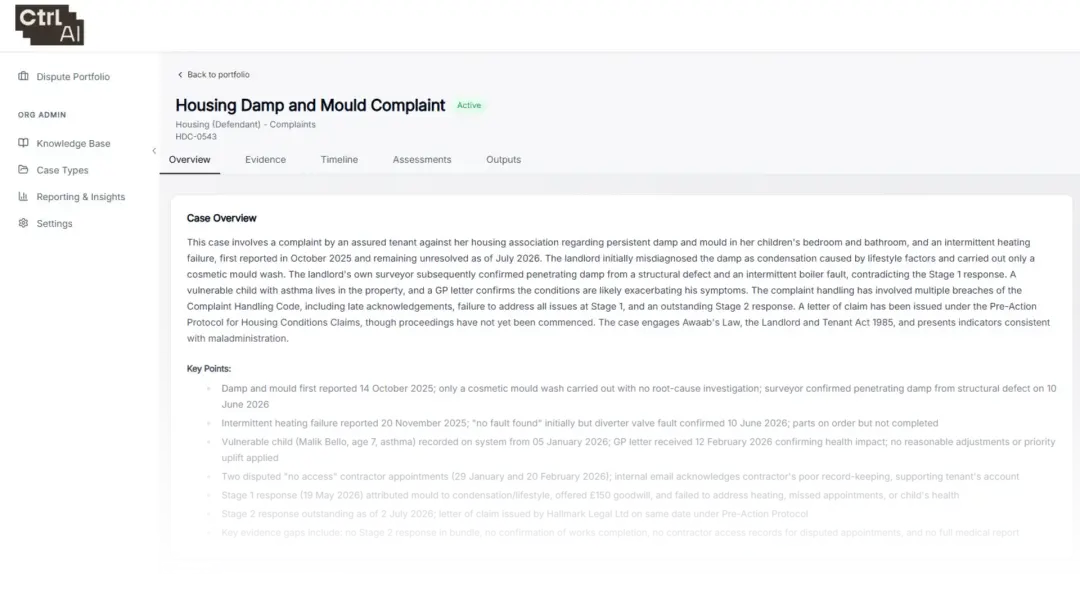
Evidence from every channel
Emails, letters, call notes, chat logs and account records brought into one place and scored for relevance.
Complaint chronology
A timeline of the original service failure and of how the complaint itself was handled, each entry linked to its source.
Rules-based assessment
Assesses each issue against your policies and the rules that apply, such as Ofcom General Condition C4, FCA DISP and the Consumer Duty, and Ofgem standards.
Triage
Escalation risk and vulnerable customer flags, with routing to the right team.
Redress
A proposed remedy in line with your compensation policy, for the handler to confirm or change.
Outputs
Final response letters, investigation summaries and ombudsman submission files, drafted from the verified assessment.
Subject access requests
Requests linked to a complaint run in the same platform, with reviewed redaction.
UK data residency
Data is held in the UK, and the platform runs alongside your CRM rather than replacing it.
Frequently asked questions
Does it replace our complaint handlers?
No. A named handler verifies each assessment before a response is drafted from it, and nothing goes to the customer until they have approved it. Ctrl AI does the gathering and first analysis.
Which rules can it assess against?
Your own policies and the rules that apply to you, such as FCA DISP and the Consumer Duty, Ofcom General Condition C4 and Ofgem standards. Each issue in the complaint is assessed separately, with reasoning the handler can check.
Do we have to replace our CRM?
No. Ctrl AI runs alongside your CRM and brings emails, letters, call notes, chat logs and account records into one timeline. Your CRM stays the system of record.
Can it help with Consumer Duty reporting?
Reporting groups complaints by cause, product and outcome across your caseload, so the failures behind repeat complaints show up for Consumer Duty reporting and fixes at source.
What happens when a complaint still escalates?
Triage flags escalation risk and vulnerable customers early. A case that does reach the ombudsman goes with a submission file drafted from the verified assessment.
Where is customer data held, and is it used to train AI?
Client data is stored in the UK and processed in the EU, encrypted at rest and in transit, and never used to train AI models. We are ISO 27001 certified, and our information security pack is available on request.
See Ctrl AI on a complaint from your queue
Start with a no-commitment trial on closed complaints.