
Case study: ombudsman
Dispute resolution at a leading UK ombudsman, under Ctrl
How a leading UK ombudsman scheme uses Ctrl AI to save up to seven hours per case, and projects a 60% uplift in team productivity.
The challenges faced by ombudsmen
A leading UK ombudsman scheme oversees thousands of consumer disputes a year against a regulated member base. Rising volumes and increasingly long, AI-drafted consumer submissions were pushing cycle times in the wrong direction. The scheme adopted Ctrl AI, the AI-powered dispute resolution platform, to keep pace with rising case volumes without compromising on decision quality. Three pressures converged on the scheme through 2025.
Rising case volumes
Case volumes rising faster than headcount.
AI-drafted consumer submissions
Long, AI-drafted submissions that take hours to unpick.
Consistency under pressure
Keeping decisions consistent across a team handling hundreds of cases a quarter.
Why the scheme chose Ctrl AI
The scheme had weighed the alternatives every chief ombudsman considers: doing nothing, generic AI tools, an in-house build or waiting for the case management vendor to add AI. None were credible at the volume trajectory and none were regulator-defensible. Ctrl AI was the only option that was live in peer schemes, purpose-built for the neutral side of dispute resolution and aligned with the regulatory bar a chief ombudsman has to meet.
The scheme was also clear from the outset that a human had to remain in the loop, with final decision-making authority on every output.
- 1
Document ingestion
Every document in the case file is read in.
- 2
Structured evidence analysis
The evidence is organised against the issues in dispute.
- 3
Framework assessment
Each case is assessed against your own playbooks.
- 4
Drafting case outputs
Letters, summaries and determinations in your house style.
- 5
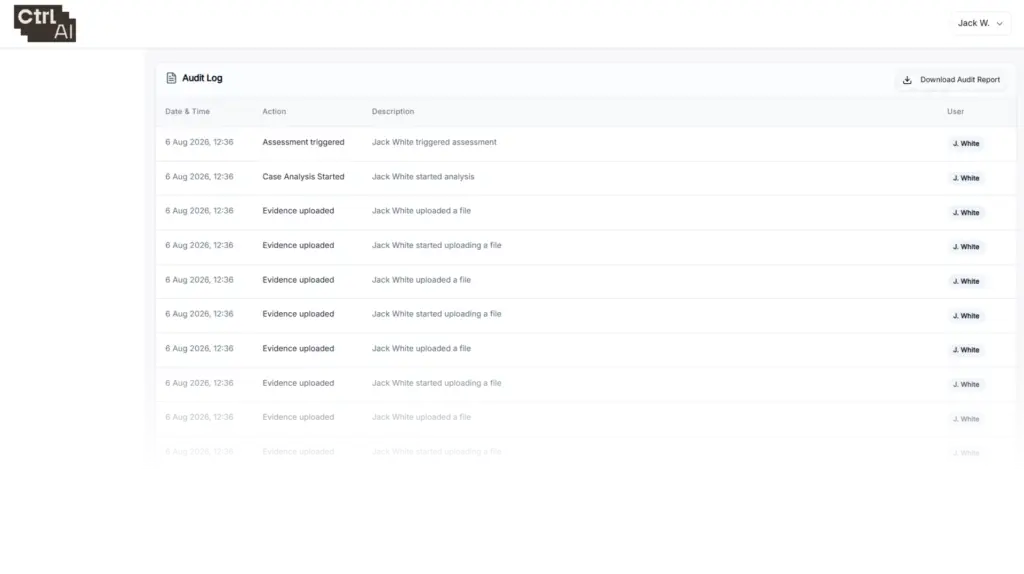
Audit trail and traceability
Every step is logged and every finding traces to its source.
The outcomes of adopting Ctrl AI
Ctrl AI was deployed across those five points in the casework process, compressing the work that does not require handler judgement and freeing handlers for the judgement work only they can do. Within weeks of going live, the scheme was handling more cases, faster, with the same handler team. Ctrl AI helped them save up to seven hours per case, and the scheme projects a 60% uplift in team productivity.
Instant scope identification
Out-of-remit cases are flagged automatically at intake, with the reason cited against the relevant rule. Out-of-scope cases are identified upfront, before they consume handler time. The response back to the consumer is fast, clear and defensible, and casework capacity is focused where it matters.
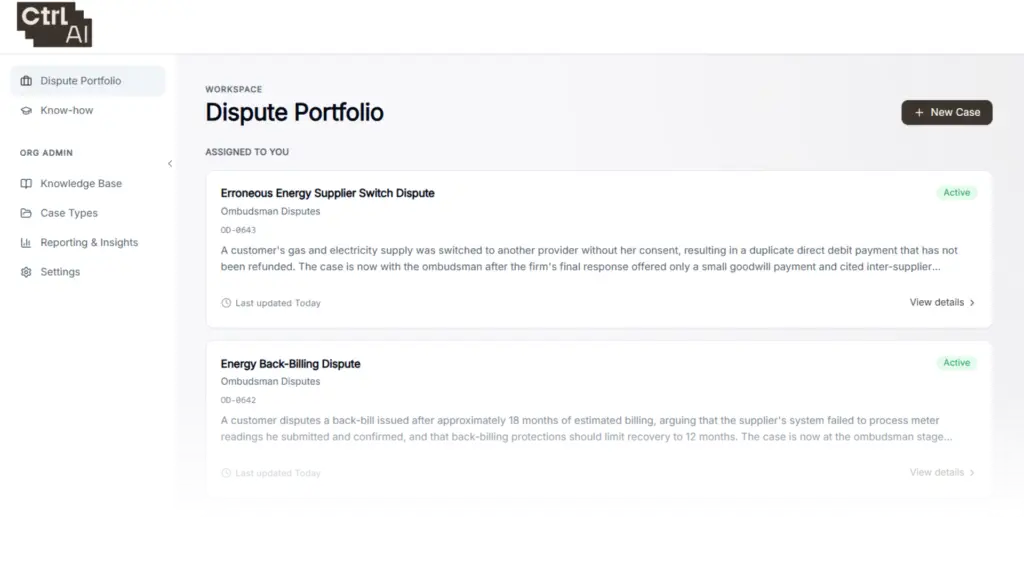
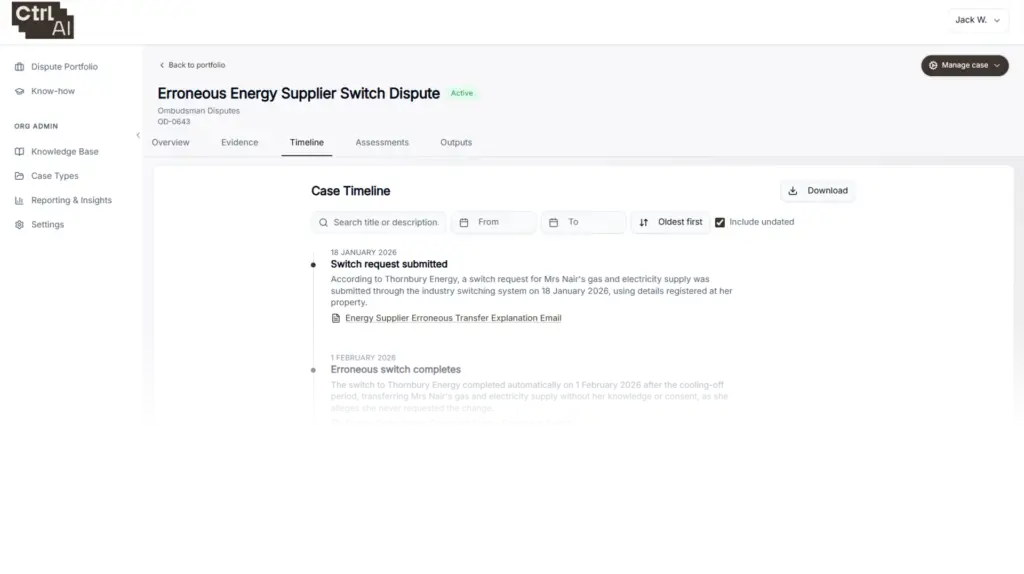
AI-powered case timeline
Every document in the case file is ingested, every event extracted and a clear chronology produced from day one. A 55-page AI-generated grievance is reduced to an easy-to-read summary, so matters are understood in minutes, not days.
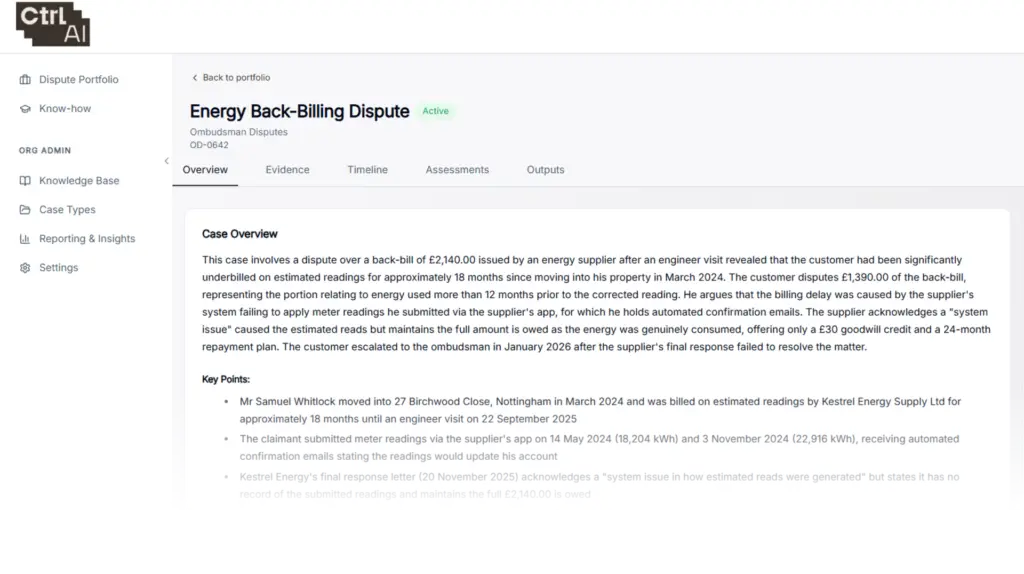
Consistent assessment against the playbook
Structured assessments run against the scheme’s knowledge base, with every recommendation citing its evidence and its scheme rule. The same case gets the same assessment regardless of who is handling it or when.
Accelerated document generation
First drafts of letters, summaries and determinations are produced from the scheme’s templates in seconds. Handlers review and edit rather than write from scratch, saving hours per case on work that does not require their judgement. Those hours are reinvested in the judgement work only handlers can do.
“What’s really got us excited is that human judgement is at the centre of the tool and the potential to strengthen quality and consistency. It’s not a decision-making tool, but one that provides structure and clarity to cases, especially in the era of AI-generated consumer contact.”
See Ctrl AI in action
Book a personalised demo to see how Ctrl AI can work for your scheme.